

Central Michigan University Athletics
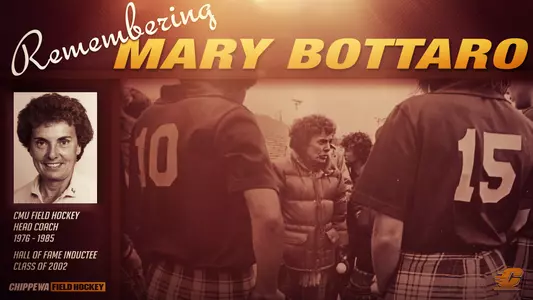
Mary Bottaro Helped Put CMU Women's Athletics At The Forefront
10/7/2020 10:20:00 AM | General
Late Chippewa field hockey coach remembered as driven, caring
MOUNT PLEASANT, Mich. -- By any measure, Mary Bottaro made a difference.
She led Central Michigan field hockey to an average of nearly 12 wins a season over a 10-year span and her teams won three AIAW state championships, three AIAW regional titles, and made three AIAW national tournament appearances.
Bottaro, who died Monday at her Mount Pleasant-area home, was a major influence on CMU Athletics and the success of her teams in the 1970 and 80s brought the university its first national recognition for a women's athletic program. Funeral services are pending.
"She was a tremendous coach," said Karen (Karner) Michalak, who played at CMU from 1975-77 and is a member of both the CMU Marcy Weston Hall of Fame and the Mid-American Conference Hall of Fame. "She always got the best out of her players and took the player's ability and always made them better.
"She did a lot for me as a mentor. It wasn't just on the field. She pushed me to be a better hockey player; she introduced me to the game and got me involved with USA Field Hockey and took me to the next level as far as trying out for the Olympic team. She encouraged me."
Bottaro led the field hockey program from 1976-85, compiling a 117-74-10 record. She was inducted into the Marcy Weston Hall of Fame in 2002 and her 1976 team, which won a program-record 18 games, was inducted in 2011.
A native of the Detroit enclave of Highland Park, Bottaro directed the '76 CMU team to a fifth-place finish in the AIAW national finals. In '77, she led her squad to a seventh-place finish.
Bottaro coached at Henry Ford High School before her arrival at CMU in the mid-1970s. Donna Provenzola played for Bottaro both at Henry Ford and at CMU. Provenzola, who finished her Chippewa career in 1976, remains the program's all-time scoring leader with 62 goals and 132 points. She too is a member of the Marcy Weston Hall of Fame.
"When I started in high school I did not know anything about field hockey," said Provenzola, who lives now in Louisville, Ky. "She taught me the game and she was relentless. When we were in high school we were the best in the state. She could take a team with no skill and make it into a championship team basically."
Symbolic of Bottaro's toughness and tenaciousness was a story that Provenzola said has been passed down over the years.
"The story that I had heard about her – she was a championship player herself and she had broken her leg when she was playing in a tournament and she still played," she said. "With a broken leg, she was out there. That's the kind of tenacity that she had."
Certainly, there was a toughness to Bottaro. But that was tempered by a kindness. She, like most good coaches, had the visceral ability to recognize when it was time to step on the gas and when it was time to hit the brakes.
"If you would get down on yourself, she was good at motivating you to not be too hard on yourself," Provenzola said. "She had a huge impact on my life. I came from a difficult family situation where if I wouldn't have had field hockey and her mentoring me at the time my life would have turned out a lot differently … She changed the trajectory of my life."
Bottaro, who is a member of the Michigan Amateur Sports Hall of Fame, earned a bachelor's degree in 1951 and a master's degree in 1957 from Wayne State University. She earned All-America honors as a field hockey player in college and subsequently gained recognition as a basketball official and as an international field hockey umpire, refereeing two World Cup Field Hockey tournaments.
Michalak, who retired in 2017 after 37 years as a teacher, said Bottaro had the respect of her players and her peers.
"She fought for her athletes," she said. "She was very much behind Title IX and things of that nature. She always pushed you to be your best and sometimes you kind of fight that battle. She wanted the best for the players and her teams. It wasn't always just about winning it was about developing the person off the field too."
She led Central Michigan field hockey to an average of nearly 12 wins a season over a 10-year span and her teams won three AIAW state championships, three AIAW regional titles, and made three AIAW national tournament appearances.
Bottaro, who died Monday at her Mount Pleasant-area home, was a major influence on CMU Athletics and the success of her teams in the 1970 and 80s brought the university its first national recognition for a women's athletic program. Funeral services are pending.
"She was a tremendous coach," said Karen (Karner) Michalak, who played at CMU from 1975-77 and is a member of both the CMU Marcy Weston Hall of Fame and the Mid-American Conference Hall of Fame. "She always got the best out of her players and took the player's ability and always made them better.
"She did a lot for me as a mentor. It wasn't just on the field. She pushed me to be a better hockey player; she introduced me to the game and got me involved with USA Field Hockey and took me to the next level as far as trying out for the Olympic team. She encouraged me."
Bottaro led the field hockey program from 1976-85, compiling a 117-74-10 record. She was inducted into the Marcy Weston Hall of Fame in 2002 and her 1976 team, which won a program-record 18 games, was inducted in 2011.
A native of the Detroit enclave of Highland Park, Bottaro directed the '76 CMU team to a fifth-place finish in the AIAW national finals. In '77, she led her squad to a seventh-place finish.
Bottaro coached at Henry Ford High School before her arrival at CMU in the mid-1970s. Donna Provenzola played for Bottaro both at Henry Ford and at CMU. Provenzola, who finished her Chippewa career in 1976, remains the program's all-time scoring leader with 62 goals and 132 points. She too is a member of the Marcy Weston Hall of Fame.
"When I started in high school I did not know anything about field hockey," said Provenzola, who lives now in Louisville, Ky. "She taught me the game and she was relentless. When we were in high school we were the best in the state. She could take a team with no skill and make it into a championship team basically."
Symbolic of Bottaro's toughness and tenaciousness was a story that Provenzola said has been passed down over the years.
"The story that I had heard about her – she was a championship player herself and she had broken her leg when she was playing in a tournament and she still played," she said. "With a broken leg, she was out there. That's the kind of tenacity that she had."
Certainly, there was a toughness to Bottaro. But that was tempered by a kindness. She, like most good coaches, had the visceral ability to recognize when it was time to step on the gas and when it was time to hit the brakes.
"If you would get down on yourself, she was good at motivating you to not be too hard on yourself," Provenzola said. "She had a huge impact on my life. I came from a difficult family situation where if I wouldn't have had field hockey and her mentoring me at the time my life would have turned out a lot differently … She changed the trajectory of my life."
Bottaro, who is a member of the Michigan Amateur Sports Hall of Fame, earned a bachelor's degree in 1951 and a master's degree in 1957 from Wayne State University. She earned All-America honors as a field hockey player in college and subsequently gained recognition as a basketball official and as an international field hockey umpire, refereeing two World Cup Field Hockey tournaments.
Michalak, who retired in 2017 after 37 years as a teacher, said Bottaro had the respect of her players and her peers.
"She fought for her athletes," she said. "She was very much behind Title IX and things of that nature. She always pushed you to be your best and sometimes you kind of fight that battle. She wanted the best for the players and her teams. It wasn't always just about winning it was about developing the person off the field too."


Maroon and Gold Gala - 2026
Monday, April 27
Chatting Chippewas - Elmo Walton
Tuesday, April 14
CMU Athletics Connection - New Head Coaches
Friday, April 10
Chippewa Check-In
Friday, February 27