Central Michigan University Athletics
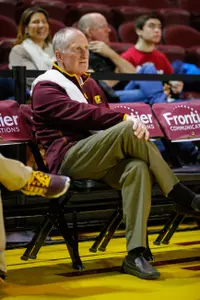
Bringing It Home
2/17/2017 12:00:00 AM | Men's Basketball
By Andy Sneddon, CMUChippewas.com
MOUNT PLEASANT, Mich. - To most, trainers are like children, which is to say they are better seen and not heard.
That never worked for John Mason.
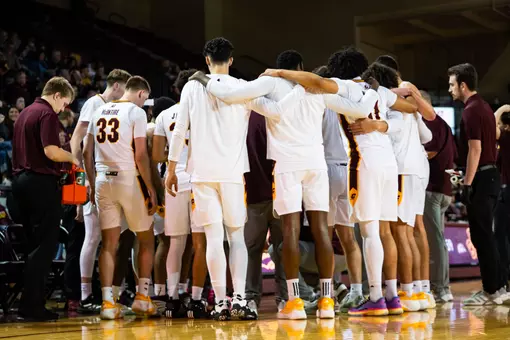
Mason will retire in May, capping a 36-year career as an athletic trainer at Central Michigan. His final regular-season home game with the CMU men's basketball team will be Feb. 28, when the Chippewas play Eastern Michigan.
The games are winding down for the Montgomery native, who graduated from CMU in 1978 and started working in the department in '81, when he was one of two full-time trainers. Today, the staff comprises seven full-timers and five part-timers.
Fewer games - the Chippewas have just six guaranteed contests remaining - means fewer chances for Mason to do what he loves, interacting with and helping players.
It also means fewer chances to chirp at officials, a favorite pastime, from his McGuirk Arena perch alongside CMU head coach Keno Davis.
"You know what you can say and what you can't say," said Mason, smiling at his well-earned reputation - cultivated over decades -- as one who isn't afraid to voice his opinion from the sideline. "I can tell you this, the level of sensitivity among officials is much greater. You can't hardly raise your voice to them anymore.
"You've got to watch what you say, but I think they need a little support out there. I think they need a little advice."
For the record, Mason has never been assessed a technical foul, so he's never crossed the imaginary line that exists from official to official. As it is, those officials may be happy to see Mason go, but plenty around CMU won't be. In 36 years, a trainer comes in contact with a lot of coaches, a lot of student-athletes.
It's that day-to-day contact, and reunions expected and unexpected, that Mason said he will most miss.
"The fun thing for me is, the last couple games, Melvin McLaughlin's been in the front row, across the (McGuirk Arena) court and he was playing when I started," said Mason of McLaughlin, the program's all-time leading scorer and a member of the CMU Hall of Fame whose playing career ended in 1983. "I still love going to talk to him after the game.
"To see those guys and have them come back and say hi to you; they kind of show their appreciation for what you did for them over time, that's the special part. I see guys who played here over the years, and that's fun. That's really fun."
Mason joined the athletic department in 1981, shortly after earning his master's in exercise science from Syracuse. It was in upstate New York that Mason met his wife Terri.
They were married a month before Mason started as a trainer at CMU, and they'll mark their 36th wedding anniversary this summer, just a month or so after he retires. They have two adult children and a third grandchild is on the way.
There was no grand plan to be at CMU for the duration. It simply worked out that way.
"You get into the flow and then you have child one, and then child two, and things continue," Mason said. "You don't plan it. All of a sudden it's 15 years, then it's 20, and then it's 25."
Mason first set foot in Mount Pleasant as a freshman at Reading High School, when he ran in the Class C state track & field meet on campus as part of the 440- and 880-yard relay teams.
"Cinder track," Mason said. "It was about 80 degrees. Just hot as heck. Your feet just burned. I can't even tell you what we did or what our times were, but I remember (the heat)."
A knee injury in his sophomore year of football was part of the impetus for a furture in athletic training.
Mason was appointed to CMU's head athletic trainer in 1986 and for a time served as the trainer for both football and men's basketball, a combination that would be impossible these days because of the ever-increasing demands of the job.
Tending to the day-to-day healthcare needs of student-athletes is the overriding and oversimplified job description. An awful lot goes into that, along with a good share of administrative duties that have evolved and mushroomed from the early days.
"This is tough on bodies, this high-level athletics, and it's a compromise to a degree," Mason said. "You're not going to feel good every day, you're maybe not going to feel good most days. We work with the student-athletes to manage that and do the things that they need to do to stay competitive."
Not unlike coaching, there an instinct that develops over time, Mason said, in dealing with student-athletes. Knowing when to push and when to pull back is a critical trait, and pain thresholds and cooperation levels vary widely.
"It really depends on the person," he said. "How they react to different approaches, and motivations. It's the same for the coaches. You can't get on this kid like you can get on that kid.
"The Bobby Knight days are over. You've got to be sensitive, more cognizant of the way you treat people in the training room and everywhere else."
Everywhere but from the bench in a basketball game.